
Project Sapling: Part 3:4
Chapter 30

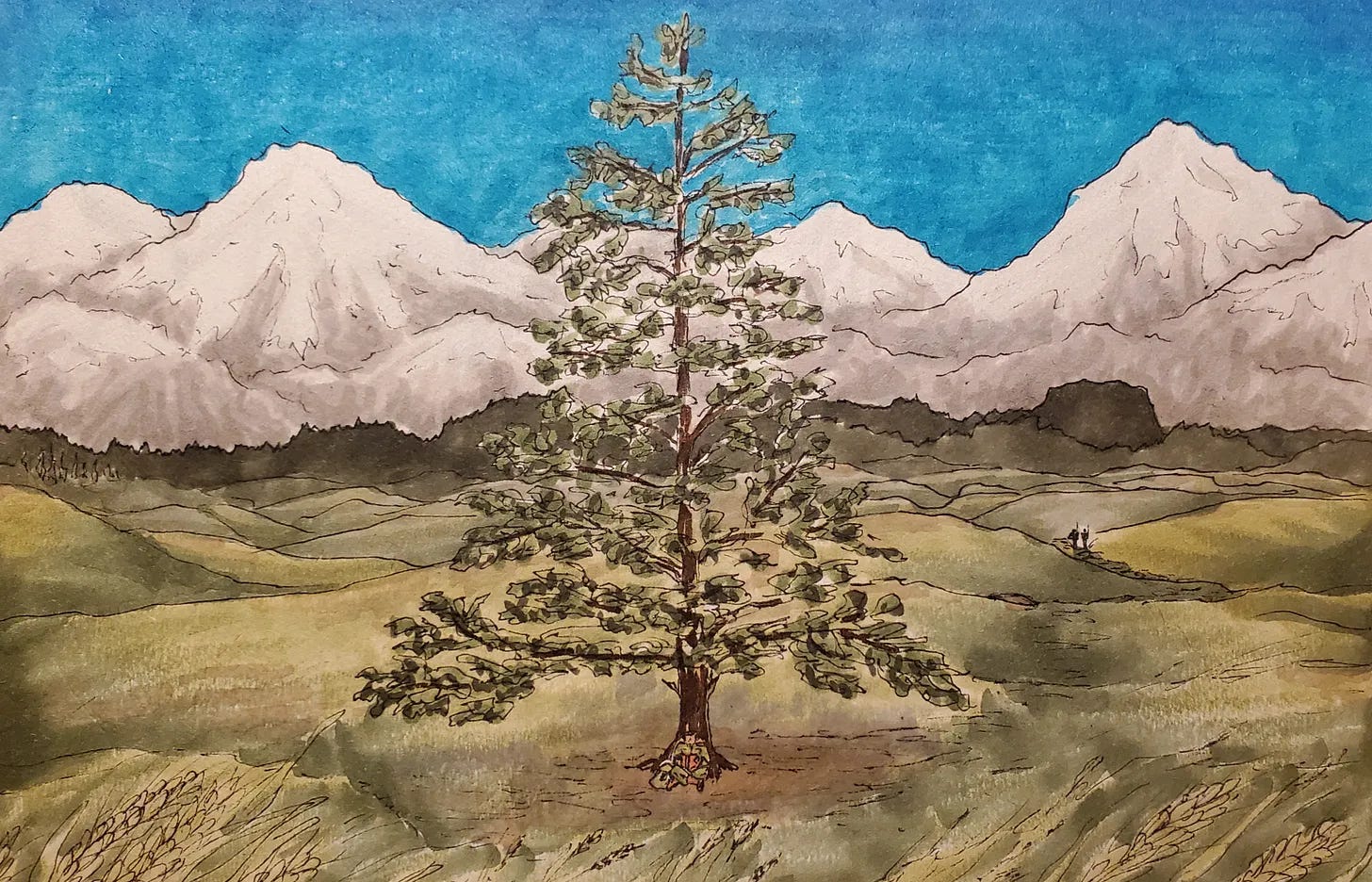
The course that Mac was teaching and we were expected to act as aids for was Basic Wilderness Survival, Pathfinding, and Tracking. Rolling into the classroom on the first day in a hip-high cast and writing full name and rank on the blackboard that had been lowered three feet to accommodate seated instruction, then spinning the wheelchair one-hundred and eighty degrees in a movement that had been practiced four thousand times in the course of the past two weeks, Mac informed the class at large that they were to be addressed formally as “Yes Lieutenant MacKenzie Sir!” and that any talk behind their back should be done with the singular ‘they’. I cringed, making the mental note to ask why I had not been corrected over the course of the past month of knowing them, and adjusted my thought process accordingly.
At least now I understood what kind of class I would be qualified to help with the instruction of. I considered myself flattered when Mac informed the class that my expertise in botanical identification and bioregional understanding was to be turned to above their own. Erica beamed when her pathfinding and navigational skills both with and without a chart were similarly held up as acing her above the level of the rest of the class. We would still be expected to complete the majority of the classwork along with the rest of the cadets seated around us, but we would also be allowed to skilltest out of any segment we claimed we were proficient at already, as well as administer skilltests to the other students, grade papers and tests not our own or each others, and were to be turned to for questions as often as or more often than Mac. As though intoning some old magic, the last words of their little speech were “Bother them, not me.”
To my surprise, the revelation that Mac had fallen in an enemy pit trap and had to be carried out on a stretcher made from saplings and blankets did nothing to dampen the class’s enthusiasm for the subject or trust in their teacher. If anything, it served to heighten their awareness that this was a class to be paid attention to, and that Erica and I were worthy of our places in the front of the classroom.
As days piled up and turned into weeks, and those in turn racked up into months, I found out that I was a passable teacher. I also found out that Mac, when not overstressed by the concept of either defection or deployment out east, was a reasonable and reliable human being, and protective of me. Before I knew it, the fall had turned into a frigid winter, which held through until the end of March, and Mac was back up and on their feet, if a bit stiffly and with the aid of a cane.
My father visited twice a month. Each time he did, he sat for a moment chatting with Mac and working a small healing on their leg, which was a thing I had not been aware previously that my father was capable of. After a few visits, I understood that their conversations were mostly to do with grief and loss. It was only after a few months of these quiet, thoughtful little chats that I understood why I had never known before that my father had healing hands when he chose to. The phrase “poured myself out all over the bedroom floor trying to save her, couldn’t pick myself up again until I had put down the bottle,” had rattled around in my head for weeks afterwards.
I still couldn’t wrap my mind around the clear and obvious fact that my father had chosen continued sobriety and continued contact with me, long after the point at which he had for years declared that he would simply give up on being alive. He seemed intent on repairing his image to me, no matter how long that was going to take. I had no idea how to react to that, sure it was a sick trap, but the efforts on his part seemed genuine.
For something called a Military Academy, there seemed to be a lot more ‘Academy’ going on than there was ‘Military.’ I soon understood the dual structure of the base, with the Regular Army training on the same premises as we were, their drills and activities taking over the majority of the base as their new basic training classes cycled through with regularity, the shouts of their drill instructors echoing over the base and sometimes drowning out our own instructors. The Youth Corps concerned itself mostly with academics and preparatory studies, while what was casually referred to as “Foot Work” was reserved for a two-hour block in the afternoons. I quickly understood that the brutal routines we witnessed the Regular Army performing had long since been eliminated for the underclasses, with a softer, gentler kind of training being reengineered from the basic workbook to not completely ruin underdeveloped bodies. We would be working up to what we saw through the classroom windows, we were told, with one instructor singling me out in particular as a person who would be absolutely wrecked by the kind of intensive physical demands made on the fully grown soldiers. I cringed under the attention, as my classmates simply nodded and agreed that if I was forced to march fifteen or twenty miles carrying a heavy load, my body might crumble under me and never recover.
It took until spring thaw brought bright green mosses out on the black basalt and pulled the lobed leaves of the buttercups up through them before we were expected to return into the field, this time on an examination expedition to test the proficiency of Mac’s class. All three dozen of us, plus Mac and Acton as supervising officers, were once more dropped blindly into the wilderness, this time expected simply to find our way out as a group, back home and safe and with no injuries, while subsisting off the land the whole way. Even the short rations Mac had brought into the field for our initial drop were withheld, simulating an emergency retreat over hard territory.
I taught the class how to brew pinetip tea, and which trees to absolutely not make pinetip tea from, and showed in the field a wild purple camas, delicious and nutritious, versus its lookalike cousin the white death camas, separable only by the color of the flowers. We identified swathes of feral grain by the remains of the previous year’s growth, and plucked armfuls of maple flowers and wild onions. Erica helped the other students learn how to navigate both with and without a compass, based on time of day, location of the sun, and distant landmarks. I was not required to hunt on the trip, having already proven my ability there, but I did teach the rest of the class the art of salting, curing, and smoking their kills.
The night we sighted the far-off glow of civilization on the horizon, after everyone else had rolled themselves up and gone to sleep, Mac finally told me about Sydney, and the disaster that had been the last July. “Look, I’m... Really, really sorry I was such an asshole at you at first. I was just... I was scared, okay. Scared of you and scared of getting attached to you and scared of not getting attached to you and...” Mac shook their head, staring off at nothing. “If I could do that over I would. You’re smart and funny and friendly and compassionate, and I’m sorry I misjudged you because you’re big and had one truly bad day.” I had gained an inch in height in the course of the six months we had known each other. “Now that I’ve met your dad I’m terrified you’re going to suddenly become a giant on me.” So was I, in all honesty. I wasn’t sure what I would do if I was to suddenly become even more gangly and unwieldy than I was.
Mac cackled, once again shaking their head, and sipped at the cup of hot pine water we had been sharing. “You need to eat more. You’ll never bulk up enough at this rate, and then we’ll have to hold you back a year and you’ll have to repeat a year just because you’re too skinny to live. We’re going to be going on more of these trips now, and I need you to be able to keep up.”
I winced. Mac must have noticed that the little weight I had put on over the course of the winter had melted away again as soon as I was in the field again. I hadn’t considered that this could mean I could be separated from my classmates, who for some reason had decided that I wasn’t bully fodder, actually, and had been on more than one occasion rallied by Erica and the irrepressible Del to congregate around me spontaneously as a living wall against the older boys who still persisted in attempting various torments against me.
I vowed to do my best to become less of a waif. I refused to lose Erica to a technicality of bureaucracy. Even if that did mean forcing myself to do something that I personally found unpleasant and pointless.
I arranged for an extra shift in the pastry kitchen for the next quarter. The ability to create treats had lead, inexorably, to a shift in my thinking, from regarding anything sweet as a block of sugar, to seeing the ratio of the constituent parts and how to put them together into something good. Somehow, the knowledge that the fancy cremepuffs were mostly egg and grain made the concept that I should eat three or four of them more appealing and less terrifying.
When I revealed why I wanted extra kitchen chores, Grandad gave me a sympathetic talking to about needing to get friendly with more than sweets if I wanted to live, and assigned me another extra shift once per week in the general mess kitchen as well. That had the desired effect as I stopped seeing objects on my plate, and found myself listing off the ingredients that I had myself mixed together earlier that day in my head, making the sandy square next to the pile of leaves, berries, roots into Grain, water, oil, yeast, salt, sugar. When I had not put the food together myself, my mind set to work reverse-engineering what the probable constituents were, playing a guessing game with the food before me and prompting me to eat the things to find the tastes and textures and hidden gems of spice or salt or sweet in order to identify the parts.
By the time our academic examinations rolled around, I had submitted to the pressure and outgrown my uniform in both directions at once. I didn’t want to admit that for the first time in my life I didn’t feel exhausted after a short run, or that I actually didn’t mind not having to ignore the gnawing sensations in my bones. I had found that I liked making bread, and that butter was my friend, and I was afraid to admit that, lest it be taken away.
I was shocked to learn that the academic year gave us our liberty for the summer months in keeping with the rest of the schools in the surrounding area, and that the Military side of the academy reduced requirements for students during the summer as well. We could chose to continue taking electives over summer, or participate in makeup work, or volunteer to take part in the regular army’s combat drills.
Erica and I would not be granted any of those options, however, since we were required to assist Sir Acton and MacKenzie, whose hip had finally healed enough to allow for fieldwork, in leading a group of two dozen volunteers through Bush Training for most of July. I now understood what “more of these trips” meant. I also understood why, given the previous July, Mac had insisted that I bulk myself up enough to keep up with the group. The unspoken request, to stay with them and keep them whole during what could easily result in Mac falling apart and breaking out into rages at recruits out of fear again, hung in the air between us like a rope binding us together. I stayed close.
In the end, it wasn’t Mac that I was needed for.
Volunteered cadets had been sent on ‘milk run’ Bush Training routes since Grandad’s day. He said that it wasn’t unusual for the youngest child or grandchild of someone in political power to volunteer for the Youth Corps out of some misguided sense of duty a la Del, and that it wasn’t good for funding to get them killed by sending them to the wrong district. To that aim, we were headed back from a trade mission exchanging a pallet full of reams of textiles for several thousand pounds of grain from another little city-state that officially didn’t exist on the boarder between the Unified Central States and Cascadia, this time far south, when recent history repeated itself horribly.
We were traversing a segment of channeled scabland, picking our careful way between jumbles of jagged rock and steep, craggy ravines, basalt formations cracked by time and weather and the activities of war making a martian landscape that was difficult to guide the ancient, chugging warhorse of a motorbike through by itself, much less dragging a tagalong with a pallet of grainsacks. I had refused to try, bursting into tears and humiliating myself in front of everyone when I had been ordered to take a shift, my vision filling with memories of breaking glass and crunching metal and the sheer gut-wrenching un-motion of a vehicle coming to an abrupt stop.
Erica, still protective and unerringly good at adding her own twist to a situation, had understood what had happened immediately, glared at Sir Acton, signed him something too quickly for me to catch, and then hopped on the bike without hesitation and revved it into life. She was a month short of her fifteenth birthday, and had grown only more emboldened as she was consistently praised for her Natural Leadership Skills, which I was beginning more and more to think meant making others pay attention to her no matter what the situation was. Sir Acton had relented, saying that she was volunteering in my place, and that therefore I should take up her place and walk at the head of the line with him.
Once I had contained myself again, I pulled up to walk next to Sir Acton, who was stroking the lean black cat lounged around his shoulders with a detached frown, face distant. “I didn’t consider that your history was still so recent. I should have known better. I am sorry...” I hadn’t expected an apology. Had what Erica signed been “crash”? I could only guess that it had been something to that effect – I didn’t expect others to connect the dots of my behavior so easily. It was like her to understand so immediately and spring into action to intervene.
Before I could answer him, the sounds of helicopters hit us, freezing me in place and jolting Sir Acton into rapid movement. I could feel the strange shimmer of a vanishment working in the small hairs on the back of my neck, and when I turned to look both Mac and the bike, tagalong and rider along with it, simply were not there.
What was there, buzzing up out of a gorge less than half a mile away, were three little bulging TIGs, bearing down on us with a barrage of machine gun fire.
Sir Acton pushed me bodily into the ravine we had been walking along, shouting orders back along the line to get to cover. I had been taught, in the interim between my own bush training and this one, how to actually roll into a fall and take the impact, and pulled myself to my feet unharmed, watching as the rest of the line of cadets joined me in my providential trench. Of Erica and Mac there was still no sign, though I suspected that was a good thing.
Not all of the recruits we were guiding were at all gainly in their movements, and I felt more than heard the sick wet snap of bone as one recruit tumbled to the ravine floor next to me. The recruit cried out, once, then stuffed one fist into their mouth to stifle the sound while curling around the other arm protectively, still lying where they had hit the ground.
I was kneeling next to the sweating, keening cadet, sound barely muffled by their fist, before I understood that I was in motion, pulling my pack off and swiping the medical kit from the place where I had put it the night before, and was wondering who was speaking to the cadet under my hands as I coaxed them out of their curled position, until I realized it was myself. “Come on now, let me see. Same thing happened to me last year, let me help. I’ve got the kit right here. There we go, that’s better, let’s get you stabilized.” I had pulled the kit out automatically, mind replaying every moment of my own broken wrist over in my head and overlaying it with the medical training I had already completed in a clinical manner that lent no emotion to the steps involved in straightening, setting, and splinting the injury in front of me. I wasn’t even fully conscious of what I was doing, hands moving with the automatic motion that sometimes got me in trouble, until I had finished the work and made the final pass over the broken bone with a pulse of energy like green growing vines and light through leaves and the sound of water.
The bone set, my vision cleared, and I realized that I was being stared at by multiple sets of eyes for the second time in half an hour, this time with a certain amount of awe. Sir Acton was regarding me with an intent stare that I found off-putting, and was certain would lead to nothing actually good for me.
Before anything could be said on the matter, a volley of rifle fire rang out, two loud, slow antiques firing in concert, and the sound of helicopters tearing themselves apart at the gears and the explosions of gas tanks ripped through the afternoon air. A few moments later, Mac hopped down into the ravine, grinning like a maniac, and reported that the enemy was neutralized and we were safe to come out from cover. A moment later, they registered that I was still being stared at with reverence while I hurried to repack the medical kit and assist the injured cadet to their feet. “What happened here?”
When we got back to base, our package intact and the broken wrist the only injury sustained on the journey and already knitting well, I was betrayed by my comrades.
I stood, cringing, in front of Grandad, while Mac and Sir Acton ratted me out for secretly being a healer.
Grandad had laughed.
There was nothing secret, I was told, about my healing skills, simply latent. Their sudden emergence, it seemed, was simply a result of finally having enough energy in my own body to sustain myself while working them. “Can’t light an empty lamp,” was the laughing explanation. “Have to put oil in it first.”
I was then assigned my specialist training first out of any of our class, immediately shunted to the Medicmage unit and told I would be required to attend those classes on top of any prior duties I was assigned. My shifts in the kitchens would continue, and my role as Mac’s Teaching Assistant, continuing to grade tests and papers and assist cadets with their work and field tests, along with my regular training and classwork. I was beginning to understand what Mac had meant when they had said that there was very little reward for the work of being a Teacher’s Pet.
My dislike of blood, I was told, was something I would just have to figure out a way around. I was sure this was a mistake, and that I was going to wash out before the end of summer after passing out in the middle of an examination or something to that effect.
***
In the end it would be Oscar’s talent, and my relative lack of it, that would separate us. His studies nearly doubled with the addition of Medicmage courses, leaving him up far into the night, long past when we were supposed to be in bed, studying anatomy and chemistry and the energy flow of the body, and where once we shared most of our classes, we were now left sharing only the basic required academics and drills, while he was shunted away after Foot Work to the Specialist classrooms for hours while I was left doing general training with the rest of the class.
There were only so many times I could do rifle drills or map out an expedition route before I was going to explode, but I sensed that complaining to my overtaxed, overstressed brother that I wanted to be doing more would not go over well. He wasn’t sleeping enough, I knew, and would not thank me for centering myself in his frustration. Instead, I did my best to keep myself from envying him for finding so snug of a niche already.
I was probably the only person not shocked by the fact that he was a healer, including himself. I had known, or at least understood, that part of his being since he had pushed me into the river. The wash of his power had pushed my personal horrors out of my mind and body and kept them at bay for almost a year already. With some meat on his bones, his shoulders finally filling out his jacket and his face no longer looking hollow and desperate, no longer skinny enough to count his ribs when he went to change his shirt, the feeling of safety that he created was all the more palpable, and it didn’t surprise me that he was actually able to physically manifest that utter need he had to help those in pain around him.
I wished I had as clear of a set of talents as he did. For the most part, I understood that “shooting well” and “Things explode” were good talents for a soldier, as was “good at maps” but I didn’t seem to be able to impart wisdom about anything past the “shooting” part to anyone.
I also could not escape the niggling envy and resentment at the knowledge that my brother’s power lay in healing and rebuilding, while mine seemed to lie only in the direction of destruction. I tried not to let that bother me too badly, nor let it stand as a portent of the future.
What I did not envy was his load of academic work, his lack of sleep as his homework kept him up long past the official lights-out, his frustration at needing to memorize the minutia of anatomy and medicine that could be all that stood between a soldier and an amputation in the field. I knew he was dreading the need to put what he was learning into practice. By that point I understood all too well why the sight of blood made my brother stutter and fumble, and was just as afraid as he was that the first time he was called to suture something in the field he would simply pass out at the sight. I could only hope that Grandad’s quiet aim here was to instill some sense of control over those situations in a boy all too prone to panic and spin out without a clear plan. These hundreds of discreet plans to staunch a bleed and patch up a bad wound would be just as valuable as the physical bandages and tools in his kit, and I did my best not to complain about his muttered repetition of the steps to sterilize and clean and bandage whatever combat injury he was chewing through on a given night, keeping me up along with him, long past when we should have been well asleep.
I hated the classes we had to take. I preferred the ever-expanding Foot Work block to endless maths equations or the books we were asked to read to try to impart some tactical knowledge to us through the text. I struggled to understand what some of the more verbacious authors were trying to say. When I confessed this to Oscar, he gave me a pained look, explaining that ‘verbacious’ wasn’t a word at all. “Honestly you probably meant ‘verbose,’ or maybe ‘loquacious’? Both?”
I had glared at him, rolled my eyes, decided to keep my new word and use it often just to spite him, and went back to reading the novel we had been assigned. I still had no idea what a boy from the countryside wanting to join the guardsmen of the king of France had to do with strategy, but the book was engaging enough to keep reading, even if I did have to have a dictionary at hand ready to tell me what a falchion was. That, it turned out, was not a type of bird, which made the whole passage suddenly a lot more clear. Why the author couldn’t simply have said ‘sword’ was beyond me, but then I wasn’t in a position to ask.
To my humiliation, ‘good at maps’ did not mean ‘good at drawing maps’ and never had. I could see the map laid out over the landscape like a grid if I tried, but could never reverse the effect and plot it on paper properly, no matter how many tries I gave it. My calculations and measurements were always somehow off, distorted and frustratingly indifferent to my attempts to put them right. In the end, the Cartography unit was not on the table for me. My gift there lay in reading the land and finding the paths on it, not putting the paths down for others to follow.
In the end, I was shunted into “Navigation” and “Leadership” courses, which I felt were a vague consolation prize to not being assigned a specialist course until just before my sixteenth birthday. Oscar had already passed his first year in the Medicmage unit, and was assigned to complete his first run as a solo Training Officer in the field the coming fall, the month he turned sixteen. I would not be doing the same, having been suspended from field training indefinitely after another incident of nutkicking a recruit for sassing me. The fact that this little prick had been a politician’s grandson hadn’t mattered to me, but had apparently mattered enough to high command that Grandad had been forced to take me off the rotation.
With Oscar in the field without me, our room felt empty and hollow, strangely haunted by his absence. More than once in the first three days I found myself beginning a conversation in my usual way, reading out a segment of whatever book I was in and beginning to ask him for insight before remembering that he simply wasn’t there to ask. Each time that happened, I felt it like a knife to the chest, and found myself in sudden shocked panic, wondering if I would ever see him again. The chances for him to not come back from this deployment were not zero. Despite continued and escalating overtures toward peace from the Cascadian side, the BC Militia were an unceasing threat, not to be discounted.
I took to spending my free time in the office with Marz, whose injury had been flaring up again enough to necessitate the reemergence of the retired cane and near-constant attention from Idris, who still shared their room to facilitate this. Marz also would not be running trainees this month, having failed to complete the required physical fitness examinations, falling on their ass again thanks to the injured leg. Instead, we were grading papers, reading three dozen badly written discussions of what to do in case of various randomly assigned survival situations.
I had just read my fourth ten-page essay with near-identical wording and thesis on “How I Would Survive a Broken Bone in the Field” and was wondering what the ethics would be on my adding “How I Would Survive Kidnapping and Brainwashing by Gross Men” to the list of subjects, distracted by the morning’s conversation with Ondine.
My mind and body had decided to replay to me the End of Days on constant loop since August, and I wasn’t at all comfortable in my skin, an unseasonably warm October lending itself to the unrelenting fever-prickling of sweat beading on my skin, both real and imagined. Whenever I closed my eyes, I found myself facing a field of feral grain, the rolling hilly horizon dotted with ruined power poles, and feeling the sway of my denim jumper in the hot, late summer wind. I had asked my mother to tell me, in as great of detail that she could manage, and in as much of an order as she could muster, how the world we had lived in for the first five years of my life had ended. She had confirmed for me a year previously that my vision of the Phantom Firefighter had been her own self, come to her own rescue, with the aid of Grandad and a bit of powerful Magic. She had explained it to me with metaphors about knots in a string that I thought I understood, and was getting a painfully sharp suspicion about certain things.
I glanced toward Marz, who had propped their injured leg up on a pillow on their desk, frowning into a paper. “Marz, answer me a question, would you?”
“One besides that one?”
I ignored that, continuing. “The boy at the Petro-Mart–”
“Enby at the Petro-Mart,” Marz corrected, appearing glad to have an excuse not to be reading essays. “What about ‘em?”
“Yeah, I’m remembering that part of the conversation, too. So why d’y’think they said you could refer to ‘em as a boy if you needed to?”
Marz shrugged. “Because French hates me and the concept of a nonbinary gender?”
“Yeah, but how would they know you would need to be speaking French?”
Marz opened their mouth to speak, took a breath, and stopped functioning for a moment, mind obviously playing empty static. Then, Marz started swearing and did not stop, pulling their bad leg off the desk and levering themselves to their feet with their cane, and beginning to limp out of the room, beckoning me to follow. “We need to see Grandad,” was all the explanation I was given before I was dragged down the stairs and out the door.
Half an hour later we were being lead down a corridor to the door to the mailroom by Grandad, whose profanity was matching Marz’s earlier recitations and outstripping them, and then into a room that most definitely was not the mailroom. He was muttering something about “Bloody off-timing” when Marz simply limped up the steps to the large ferrous ring in the center of the only pool of light in the uncomfortably vast room, and the thing started to spin, slow at first and then with increasing speed, crackling with an electricity the same color of cerulean sky blue that the implants had made Marz’s eyes. When the electricity soared and sparked and swam into a glowing spiral that disappeared into the very center of the ring, Marz grabbed my hand and pulled me through it.
I felt as though I had been disassembled from the navel outward and then put back together from the inside out in the same instant, the sensation of my own matter changing place in time somehow toroidal. Coming out the other side of an electromagnetic induction in the same room we started in, something was nonetheless very different.
It was not, quite obviously, the first time Marz had done this sort of thing. To my relief, Grandad was a step behind us, one hand landing on my shoulder with a reassuring squeeze. “This way,” he told me, grinning, and we followed Marz out of the not-mailroom.
I hadn’t believed Marz when they had said that their excursions with the specialist branch known as the Chronocrew had left them unsure of their actual physical age. Now, being told that the event we had to take part in was a little over a week away to give us time to locate the right Petro-Mart and arrange for Marz to take the afternoon shift for the day from the regular worker, I understood. Grandad had introduced us to his younger self, and left us there, waving farewell and promising to see us in a week and a half, or a few minutes, depending on the point of view.
The Oz Roe we were left with stared at me for long seconds before speaking, fixing me with a riveting smile that held none of the paternal energy of that of the man who had just disappeared back into the mailroom. “Very pleased to make your acquaintance.” With that, we were lead away to check in with the Chronocrew and get a disbursement of civilian clothes, petty cash, a beat up green hatchback, and the address to a prepaid motel somewhere near the edge of nowhere.
The next week made me wish I had brought papers to grade. Marz knew the town we were headed to, had obviously plotted this exact route several times over, and drove slightly above the speed limit the whole way, getting us to the dusty, disrepaired motel with three days to spare. For the next three days, we stayed there, living off of delivery food and sandwiches, flopped over the creaking, lumpy beds and reiterating the details of the coming encounter that we could remember, creating a plan for what Marz was supposed to be doing.
“What if we just, like, kidnapped me? You know, just snuck out the back when you’re on the phone and take me away? What then?”
“And that’s why you’re staying in the stockroom the entire time, right there. Then history goes ‘clonk’ and we disappear in a puff of smoke to wake up with a completely different set of lives, never had the experiences that lead to us making this jump, and then all of reality gets weird until it breaks completely and then we disappear in a puff of smoke, or we get trapped in an iteration of reality in which we have our own memories but they don’t match up to the reality we’re stuck in, or possibly something even weirder. So no, off the table. Make knot, not entirely new thread.” Marz was hanging upside-down, half off their bed, staring at my boots on the floor.
“Understood.” I hadn’t considered that.
“So, start over. We roll in tomorrow morning, and?”
“I give the girl at the Petro-Mart a few hundred bucks to take the afternoon off while you stand there doing your best Uncle Will impression. And if she asks questions?”
“Matter of national securities, miss. You saw those odd people rolling through a few days ago?” Marz put on their best Federal Agent voice, and winked.
Watching the fearsome sprout that was the nine-year-old Marz jogging down the crumbling highway carrying my own near-lifeless younger self was an experience and a half. I felt the queezy, headsick feeling of being in two places at once – or rather, one place twice – and did as Marz had instructed me to do, going to lie down in the stockroom and close my eyes against the onslaught of overlapping memory.
Knowing what my father would do once we were securely back in his grasp made the impulse to break history and smuggle these precious little lights away to safety before he could do his worst return. If this story changed here, ended with the two of us disappearing into the grain, never to be seen again by my malicious father?
I rolled over, pressed my forehead into the cool concrete beneath me, and bit down hard into the pad of one thumb, forcing those thoughts out of my mind in favor of worrying about Oscar’s safety back in our own place in space and time. That was a topic, I realized, with guilt, that I hadn’t even spared a thought to since the question of how ‘the boy at the Petro-Mart’ had known that Marz would need to speak French.
I could tell that Marz had driven away with the children when the pressure on my mind eased.
Pulling myself out of what had become a fetal huddle, I pushed myself to my feet and out of the stockroom, into the Petro-Mart and out into the relatively fresh air outside. I watched the battered hatchback disappearing into the distance, relaxing my shoulders deliberately and taking deep breaths.
My life had been hard, yes. I had wished on many occasions to simply stop existing, yes. But now, at sixteen with friends I called Family and a place to call Mine, I wouldn’t give it up. Beyond that, my life had had impact beyond me, and I didn’t know what the consequences would be to any attempt to change my history.
I would rather have endured the things I did and have my life than to have some different history, but the chance that I had ruined some pivotal moment I had no idea of for someone else. I had thought endlessly about what would have happened to me had Oscar not been there to relentlessly love me no matter my faults, but I had not yet paused to consider what the outcome of the reverse would be: What would my brother be like if he hadn’t found someone to hold onto to keep him from blowing away from himself in the winds of hatred and rage those first few months? Were there others I was overlooking, people I had saved just by being in this path in time?
I had to think I must have...
I went back into the welcoming air-conditioning of the Petro-Mart, paid for the aspirin and bottled water, and snagged for myself a large bottle of iced Double Mocha Latte, the slightly synthetic and mildly burnt caramel flavouring, having managed to change not a whit in the eleven years I had jumped back though, pulling me safely back into my own mind. Thank God for corporate coffee chain mediocrity. I paid for that, too, from the dwindling allotment of petty cash we had been dispensed, keeping the receipts as ordered and wondering just exactly how the accounting department accounted for incidence like this.
From Petty Cash, $9.37 to Petro-Mart Franchise #1334, Time Travel expenses, to whit, one Sirenia brand iced coffee, $3.99, two Planes Aquifer brand bottled waters, $1.99 each, one single-dose blister-pack Aspo brand anti-inflammatory compound, $0.99, taxes misc, $0.41.
The bell over the Petro-Mart door jangled.
“...Going to whip that insolent child to within an inch of her worthless life when we find her!” His voice gave me chills, pushing me back out of my body and into the reality of the fact that I was really currently in a time in which he was alive.
I ducked behind the counter, turning my head away from the pair who had just entered, trying not to look as my father thrashed his way around the little convenience store, looking under the hot drinks counter and behind shelved and even into the cold bevo case.
Will, on the other hand, made a straight line for the counter, coming to stare at me. “Did you see... two little girls... pass by here? Maybe?” he kept his voice low, and anxiously glanced toward Arthur, who was by this point opening the door to the stock room without so much as asking.
“Hey you can’t go back there, see the sign! Are you on drugs? Stop that!” I called, pointing to the ‘employees only’ placard, before turning to Will and giving him my best flat, unrecognizing squint. “Sure, my shiftmate ditched me to take them into town a bit ago. Dunno where they were headed.” I said it loudly, flat, and with a tinge of frustration, so that Arthur couldn’t help but hear. Then I locked eyes with my uncle, leaned in closer, and whispered “It’s now or never, Will,” with all the force I could muster. Will’s eyes went wide with shock and fear. “Oz sent me,” I added, still quiet, holding his eyes and willing him to believe me. This felt... right... “Camera shop’s on fifth.” I had spent a few too many hours in a motel room not to have begun looking at the local phonebook.
And then, nothing happened. No sucking, off sensations as history went sideways, no puff of smoke, just Will, standing in front of me looking terrified as Arthur spiraled out of control.
Then he nodded, a certain tension draining out of him, and then turned to call to Arthur. “You hear that, Art? They headed into town. Let’s split up once we hit the outskirts, alright? Cover more ground.” Casting one last haunted look over his shoulder at me, Will herded Arthur out of the Petro-Mart, and I sank to the floor behind the counter.
A few minutes later, Marz returned, to find me shaking and pale, halfway through a third Double Mocha Latte.
We watched that night from the slit in the curtains of the motel window as the terrible glow on the horizon and the single fleeing vehicle signaled the end times, and then later, as first one housecar, then another, then finally all but the lone steepled truck tooled up the road and into town, back to the uneasy embrace of civilization and away from the grass and fire and Arthur’s madness. I knew that in the next two months, that madness would consume all that was left, until he made the choice to kill my mother rather than let her leave him, taking me with her. I also knew that when Mandy died, and Ondine rose in her place, the world was better for it. That was a strange sensation.
When we were greeted on our proper side of the Deus Ex Machina by a smiling Grandad, radiant in his full age and glorious in his paternal warmth, it was like the sun coming up. I was clapped on the back, congratulated on my first Chronocrew mission, handed an extra ration ticket of the kind I hadn’t seen since Oscar had been deemed an appropriate weight, and we were sent back to our housing.
It really had been only an hour or so in this point in reality since I had pointed out the logical question. Idris had just finished preparing dinner when we arrived, barely cognizant that we had been gone for more than a quick walk to stretch Mac’s aching legs.
We decided we were not required to finish grading these papers that night, or even that week, and went to bed early.
Oscar arrived home two weeks early and with a freshly fractured nose, ranting about not taking any more conscripted recruits. When the full story came tumbling frustratedly out– having been attacked and overpowered by his recruit, who defected to the first Melonhead contingent they had encountered, and barely escaping with his own life as a result, spending several days hiding alone in the scablands to evade their patrols – I had to agree. Both Grandad and Sir Acton were also in agreement, thankfully, and Oscar was assigned permanently to the Volunteer pack. Which, if we were being honest, was a much better placement for his specialty than running a singular belligerent recruit at a time through endless grain.
To my shock, I was tapped a few weeks later to the Chronocrew as a full member. My ad-lib to Will had apparently been a portion of the history that either had already been, or changed nothing enough to have not made history go clonk. I was apparently Point Sensitive, whatever that meant, and it was a good thing.
It turned out that my idle daydreaming over how the bookkeeping for timetravel expenses was conducted was almost exactly as it really was. It also turned out that I was particularly effective at opening the machine known as the Deus Ex Machina, and finding the particular point in time where things needed to be helped to flow a bit in order to happen.
That was the first law of the Chronocrew – Make it happen. No messing about with timelines, only making sure that events happen as they should. It was a simple rule. The tricky part came with the fact that I could feel the spots where tweaks needed to happen to make the whole thing flow, but trusting myself to find and work them was an entirely different matter. It came down to odd compulsions, feelings that amounted to “do this, don’t do that” at no particular trigger, and the trick came with sorting those from the regular everyday bread and butter failure of impulse control that I was.
Once it had been explained to me that those strange moments of failure to control my impulses in the face of life-changing events might in fact be the consequence of standing fifteen feet from my own child self causing a glaring gap in the place where space stored time and giving me bleedover from my own memories, I was even more confused and frightened than before. It all felt too close to the predestination that my father had frothed about, and I had the sick feeling now that I knew why his mind had twisted itself the way it had. I was having a hard time myself not falling to the grandiosity of the very idea that I held the crux of time in my palm.
The baffling thing about Chronocrew was how very ordinary most of it was. Aside from being out of time, most of it amounted to the usual grind of hurry up and wait. Be in the right time at the right place and then wait until the thing needed to happen, and then make sure it did. Most of the time it was not something as big and interesting as a near brush with oneself, almost never something as showy and uncanny as what had happened to my mother. Much of the time, the thing in question was something small and banal like slowing someone down in line at the Sirenia Coffee so they were forced into taking a later bus and therefore arrived late to their own job and in turn inconvenienced someone else into a third action which in turn somehow prevented an all-out disaster. Occasionally I found myself working with multiple iterations of Marz, almost all older by a few years than mine, and on one occasion, frighteningly, my own, much older, self. She had given me a sympathetic smile, and a simple “Hang in there, kid,” and kept to herself and her Marz for much of the mission except when interaction was utterly unavoidable. The resultant headache lasted for almost a month afterward. I wondered how Marz could stand it, and was told that it was a thing that they had adjusted to eventually.
Before I really knew it, another two years had passed in linear time, and I was facing graduation. With that came a looming wave of terror and trepidation over the prospect of being shipped east to join the Regular Army branch. They needed Timehoppers as much as the west did, it seemed.
As tensions had waned with the Cascadian forces, the boarder skirmishing on the Eastern front had only increased. The only chance of staying on the Western front came in the form of stationing within one of the handful of battalions still stationed on the Regular Army half of the base, which was unlikely, or assignment to the teaching staff, which was even more unlikely. A position hadn’t opened up since Marz had taken up the last one. It would require either the retirement of one of the staff, or an entirely new class to be constructed purely for that purpose.
There were rumours among the senior staff that the latter was going on this year, and from the few snippets of conversation I had overheard, I had a sinking suspicion that I knew what was about to happen.
It had been hearing one of the older officers in charge of weapons drills laughing about ‘Healing bullet wounds with berries and leaves’ that put the lead into my stomach.
I confronted Marz about my suspicions three days later.
Marz dragged me to go speak with Oz.
He had refused to admit me to his office, deciding instead to speak with Marz alone, leaving me to wait outside in the hallway.
I could still hear half the conversation through the door.
“...multiple instances of conduct unbecoming, no real transferable specialty–”
“No real–? Her ability to navigate blindfolded in the dark is–”
“Is not teachable, Marz. Listen to me for once, will you? She’s reckless, hotheaded, short-sighted mentally, and–”
“AND TRUSTING YOU TO KEEP HER SAFE!”
“AND I CAN’T DO THAT, MARZ!”
“What, so for him you’ll just manufacture up a class out of nowhere so you can–”
“Yes, Marz. Yes. For him, I will do just that. I will move fucking mountains for him.”
“For him, but not for her? You’ll pull strings for your own blood, but she–”
“She hasn’t given me a way to do so, Marz. Please, sit down and listen. He’s brilliant, and talented, and can teach, and I cannot waste that on sending him out to the meat grinder to be some squad medic until he burns out like his father. I cannot do that again, do you understand me?”
“But you’d do that to her?” The ice in Marz’s voice made me regret ever having thought that they didn’t care about me.
“It’s not the same with her.”
“Why? Tell me, Oz!”
“She’s not him. She’s not the same level of vulnerable that he is.”
“No, you’re right, she’s not. She’s a whole different level of vulnerable that I guess it’s been too many years for you to remember.”
There was silence for too long, and then –
“I’m sorry sir, that was out of line.”
“Dead right it was.”
“Won’t happen again, sir.”
“Better not.”
“Yes, sir.”
“Do you understand me, Marz? I am helpless in this situation. I have done what I can, and I wasn’t given the tools to keep her. Can you understand?”
“Honestly? No, sir.”
“You will eventually, Marz. You’ll hate it, but you’ll understand.” I could hear him sigh, loud and frustrated, and could picture clearly the angry set of his jaw and brow. I tried not to, not wanting to see his face as he proclaimed my doom. “She’s been asked for by name by General Preston. Her father was a favorite of his, I’m sure he’s hoping she’ll be a shiny little copy of him. Best I can do is hope she’s a wrench in his gears, see. There’s nothing I can do. Unless she manages to get herself in a hopeless situation so she won’t be deployable for a while like you did, I have no choice but to send her East. It was all I could do to save one of them, Marz. Please, don’t hold it against me that I had to let the other one go to get this.”
“The ‘other one’?” Marz sounded disgusted, and I could hear the scrape of chair legs against the floor. “Permission to be dismissed, sir?”
Another long sigh, and another long pause, and then “Permission granted. Dismissed. Just... Try to see my side of this, Marz. Please. For your own sanity if nothing else. I know you wanted to keep her. I’m sorry.”
A few moments later, Marz burst back out the door, nearly colliding with me.
I didn’t need to be told, and Marz could see that they didn’t need to tell me.
Instead, we went for a long walk, Marz fuming silently for half an hour before bursting into frustrated belligerent profanity on the subject of men who protected other men at the expense of women.
I hadn’t even thought of it that way until that moment, and the horror of that took me by surprise. Until that moment, the dumb resignation had simply been that my Grandad wasn’t actually mine, and that he had chosen to protect his own kin over those he had taken in. “That’s not it,” I corrected Marz, woodenly, and added my own observation over the power of bloodlines. That only seemed to make Marz angrier.
In the end, we procured a pass and walked into town, going to ground in the air-conditioned sanctuary of the Sirenia and ordering the largest blended iced double mocha lattes they offered, the slightly burnt coffee soothing both our nerves. Finally, after both of our nasty coffee drinks were long gone and we had had the same frustrated conversation four times over, agreeing that it wasn’t at all fair, we made our slow way back to the base, Marz dragging me upstairs to the office and fishing a bottle of bottom-shelf, probably flammable rum from the the bottom drawer. “Here,” they muttered, tossing the thing at me. “Doomed man deserves a drink at least. Go to bed, Cole, get some sleep. Things won’t look any better in the morning, but at least you’ll be less tired.” Marz hesitated, giving me a long look before continuing. “You know, I hate to mention this, but... You know your stepmom is still enlisted, right? Just on extended maternity leave... You might... want to think about that...”